







News in October 2026
What does the BVV requirement mean for my business? How can I start my business faster? What do I need to keep in mind when changing the company name? We answer these and a few other questions in our Ocotber newsletter. In the “nhs* inside” section, our colleague Yuka explains why she ended up becoming a tax clerk instead of a florist.
nhs* spotlight
- What does the BVV requirement mean? Electronic payroll records starting in 2027
nhs* tax news
- “Fast-Track Business Start-up” corporate project
- Changes to the input tax refund procedure
- Input tax deduction in the event of a name change
- Sales tax on rentals through Airbnb
- E-Invoice Update: recommendation for automated validation
nhs* inside
- Yuka, who has been with the nhs* for eight years, in an
interview
- nhs* live: Staying up-to-date
nhs* spotlight
What Does the BVV Requirement Mean? Electronic Payroll Records Starting in 2027
What will apply starting in 2027?
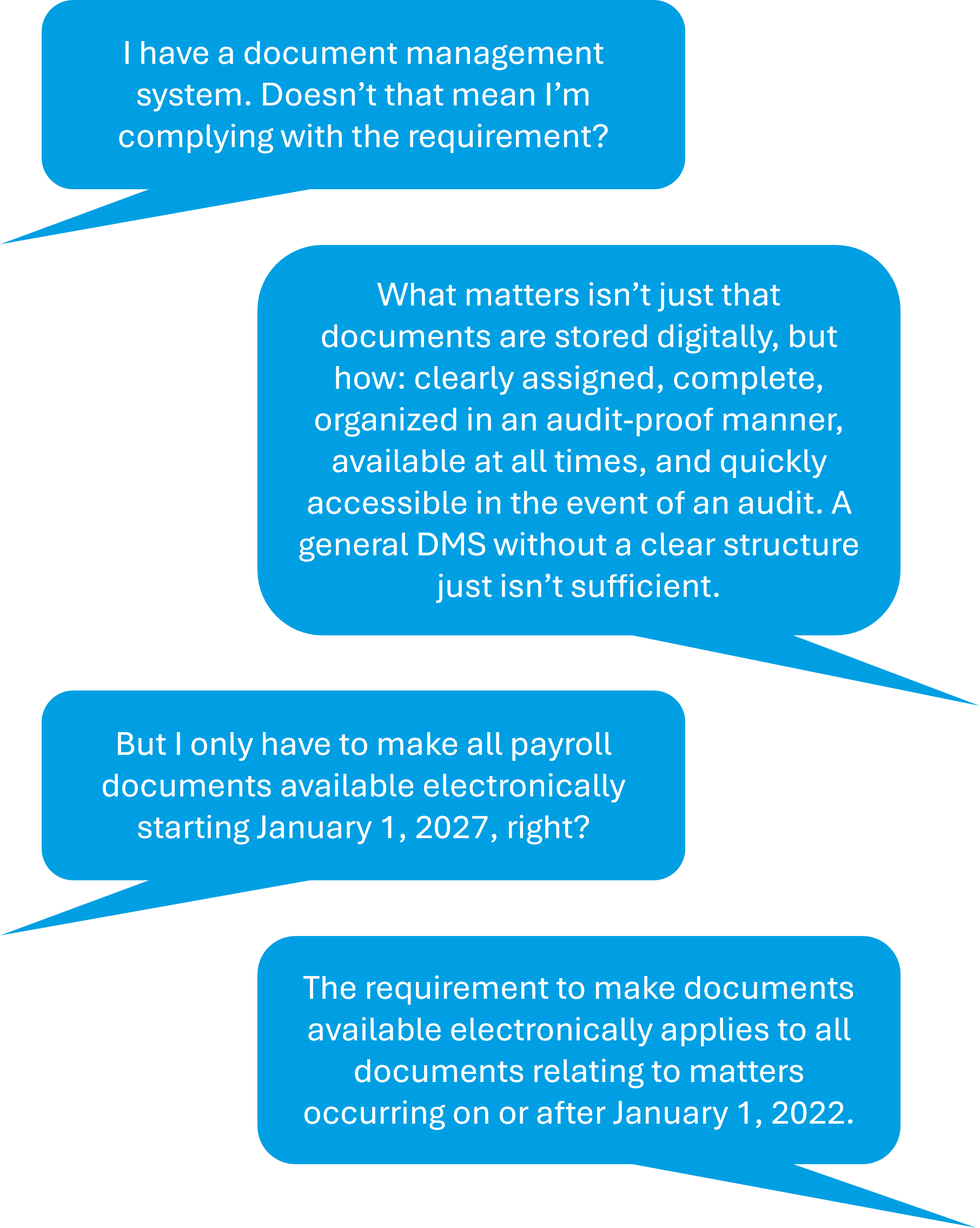
Starting January 1, 2027, all compensation records relevant to audits must be stored centrally and digitally in a single location. Paper files, email inboxes, and local drives will no longer be accepted during audits. This applies to all employers subject to audits by the German Pension Insurance. Digital storage alone is not enough: The records must be machine-readable, immediately retrievable, and fully traceable.
Which employers are subject to this requirement?
The requirement to maintain payroll records electronically applies to all employers. Even if parts of payroll processing are outsourced, the obligation to properly maintain payroll records remains with the employer. The size of the company, industry, or number of employees is irrelevant. As soon as a company has employees, the requirement applies without restriction starting in 2027.
What about exemption applications?
Until now, employers could apply for an exemption from the requirement to maintain electronic payroll records. This exemption option is valid until December 31, 2026; after that, it will no longer apply under any circumstances. Even if a company submits an exemption application today, it will only be valid until December 31, 2026.
What does this change mean?
| Requirement | Current Situation (Hybrid Solution) | Starting in 2027 |
|---|---|---|
| Storage Location | Distributed across paper folders, email inboxes, and local drives | All documents must be stored centrally and digitally in a single location |
| Retrievability | Documents exist, but often must be located first for an audit; PDFs may still be used with approval | Documents must be immediately retrievable and made available directly |
| Data Quality | Documents exist in multiple copies or in different versions | Each document must be unique, up-to-date, and assigned to a specific person and time period |
| Audit Format | On-site inspection, often involving paper documents | Digital audits (euBP) with data transmission and automatic evaluation are on the rise |
Which specific documents are affected?
In § 8 Abs. 2 BVV, you will find a complete list of the affected documents. These are the most common in practice:
- Documents regarding citizenship and residency status (work permits, residence permits pursuant to § 19c AufenthG in conjunction with § 15d BeschV)
- Health insurance membership certificates
- Enrollment certificates (e.g., for working students)
- Applications for exemption from mandatory pension insurance (particularly for “minijobs”)
- Declarations by short-term employees regarding other short-term employment
- Notices from health insurance providers determining insurance obligation or exemption from insurance
- A1 certificates for posted workers
- Proof of parenthood (for the purpose of differential contributions in long-term care insurance)
- Decisions by tax authorities that certain payments do not constitute wages
What are the technical requirements?
Generally, standard, long-term readable formats are permitted, such as:
- PDF (ideally PDF/A for long-term archiving)
- TIFF
- JPEG / JPG
- PNG
- BMP
Important: Each document should be a separate file. Combined scans make it difficult to assign them correctly.
nhs* tax news
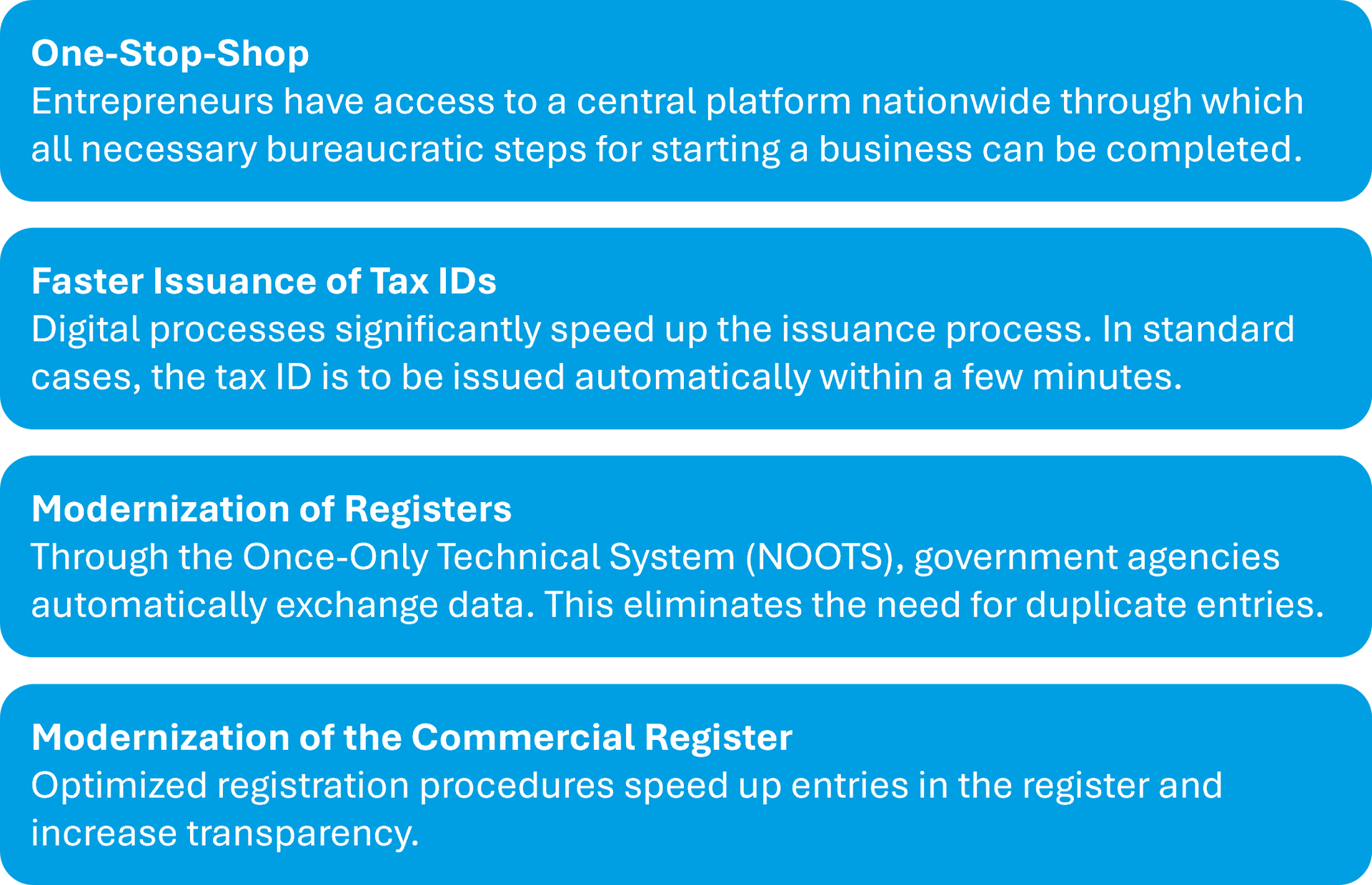
“Schneller Gründen” Business Project Launched — Combined Application for Business Registration and Tax Registration
The “Schneller Gründen” project (“Fast-Track Business Start-up”) aims to make starting a business in Germany easier, faster, and fully digital. This was announced by the Federal Ministry for Digital and State Modernization.
For the first time, a seamless digital combined application is being tested, which combines business registration and tax registration into a single, fully digital process. The goal is to accelerate the startup process for companies and make administrative procedures more efficient.
In addition to
Düsseldorf, seven other locations are participating in the first pilot phase: Aachen, Dresden, Fulda, Goslar, Mannheim, Munich, and North Frisia.
During this phase, the new procedure will be tested under real-world conditions and further developed based on practical experience.
Changes to the Input Tax Refund Procedure
Starting January 1, 2026, companies not based in the EU must, as a general rule, submit digital proof with their applications for input tax refunds.
This means:
- Invoices and import documents must generally be uploaded via the online portal of the Federal Central Tax Office (BZSt).
- This requirement applies to documents with a total amount exceeding 250 euros.
- For documents up to and including 250 euros, this documentation is generally not required. However, the BZSt may still request the documents on a case-by-case basis.
- In addition, a detailed breakdown of the input tax amounts claimed must be submitted.
- In exceptional cases, the documents may also be submitted on a storage medium (e.g., a USB flash drive) during a transitional period.
- Proof of business status may be submitted along with the application. The BZSt may request the original in individual cases.
The new regulations apply to applications for input tax refunds submitted
after December 31, 2025. They are intended to simplify the procedure and bring it more into line with the regulations for companies based in the EU.
Input Tax Deduction When a Company Changes Its Name
The Federal Fiscal Court (BFH) must determine whether an invoice can still be valid for input tax deduction if a company is in the process of changing its name.
Specifically, the case in question is as follows: A company is in the middle of a name change. It is already using the new name on the invoice, even though the old name is still officially valid. In other words, the invoice was issued under the future name.
The question now is: May the customer still deduct the input tax from this invoice, or can the tax office deny the input tax deduction solely because of the incorrect or not-yet-valid name?
On April 29, 2026, the Federal Fiscal Court decided to examine this question in greater detail. It thereby granted leave to appeal a ruling by the Berlin-Brandenburg Fiscal Court dated November 12, 2025 (Case No. V B 118/25; Berlin-Brandenburg Fiscal Court, Case No. 5 K 5140/24). This issue is relevant because such cases can occur more frequently when companies change their names. It now remains to be seen how the Federal Fiscal Court will ultimately rule on the matter.
Sales Tax on Rentals Through the Airbnb Platform

Anyone who rents out their apartment or vacation rental through Airbnb may be considered a business owner for tax purposes even without registering a business.
In general, the long-term rental of residential property is exempt from sales tax. However, this exemption does not apply to short-term rentals, such as those common with vacation rentals and Airbnb. The income may therefore generally be subject to sales tax. For pure lodging services, the reduced tax rate of 7% generally applies; certain additional services may be taxed at 19%.
The small business exemption may be applied if the statutory revenue limits are met. In this case, while rental income is VAT-exempt, an important peculiarity regarding Airbnb remains: Airbnb is based abroad and charges the landlord fees for using the platform. In principle, the German landlord must pay 19% VAT on these fees to the tax office under the reverse-charge procedure. This also applies to small business owners.
Those who are not small business owners can generally claim this sales tax as input tax at the same time, so that it usually does not result in an additional tax burden. Small business owners are not entitled to input tax deductions and must actually pay the sales tax on the Airbnb fees.
Small business owners, in particular, should therefore ensure that they report the Airbnb fees for tax purposes correctly. Otherwise, additional payments and late payment penalties may result.
E-Invoice Update: Recommendation for the Automated Validation of Incoming Invoices
Since January 1, 2025, businesses have been required to be able to receive e-invoices. A standard PDF file sent via email is no longer explicitly considered an e-invoice for VAT purposes. Instead, formats such as XRechnung or ZUGFeRD (version 2.0.1 or higher in the EN 16931 profile) are required, as they enable full automated processing of the invoice data. As a general rule, it should be assumed that errors will occur from time to time even when creating e-invoices. Therefore, it is recommended that the accounting or ERP system used not only receive e-invoices but, ideally, also be able to automatically validate them for potential errors.
The tax authorities distinguish between three categories of errors:
- Format errors: The invoice file does not comply with the permitted syntaxes or their technical specifications; correct and complete extraction is not possible → Invoices are not e-invoices but are classified as other invoices.
- Business rule errors: Content errors (inconsistencies within the structured file), such as contradictory information or missing content in required fields
- Content errors: discrepancies in content relative to the legal transaction underlying the invoice, incorrect service period, and other inaccuracies
Erroneous invoices can pose problems for the recipient, as defects may, in certain cases, affect the input tax deduction. Therefore, a correction should be initiated promptly in the event of erroneous incoming invoices.
The Federal Ministry of Finance has established a question-and-answer catalog (only available in German). This catalog, which is continuously updated, serves as a current and authoritative guide for businesses.
nhs* inside
Why a Tax Clerk?
Our colleague Yuka talks about her journey to Germany and how she eventually came to work with us.
What were you doing before you joined nhs*?
After studying international relations with a focus on economics in Japan, I came to Germany for a language immersion program because German was my second foreign language in college. That’s when I met my husband here. After the birth of our first child, we actually only planned to return to Japan for a year. That one year turned into 13 years. In 2011, we finally returned to Germany. First, I took an integration course to improve my German skills from B2 to C1, since I wanted to start working in Germany. Then I registered as a job seeker with the Employment Agency, and since I’d been out of the workforce for so long, they suggested I pursue
retraining. The agency had a huge catalog offering many different training paths, and at first I couldn’t decide at all. I was on the verge of becoming a
florist, but then I decided to pursue
training as a tax clerk instead. Those are pretty different professions.
How did that come about?
Here’s how it happened: At first, I was interested in something hands-on, but then I had the idea to do something that would also help me
in my personal life. I wanted to understand bureaucratic German, tax returns, and the system behind pension insurance, because in Japan, of course, everything works very differently than in Germany. The retraining program to become a tax clerk was a two-year program consisting of one year of theory and one year of internship. For my internship, I wanted to find a position where I could also have something to do with
Japan. And that’s how I eventually ended up at nhs* through an acquaintance. When I started in 2018, we had fewer than ten employees.

What has kept you at the nhs* for so long?
It’s the people here that make the difference for me. I get along well with everyone. The pandemic was, of course, very stressful, and there was a brief moment when I wondered if I should “switch sides”. I wanted to be the one asking questions of my colleagues for a change, rather than just being the one who has to have all the answers. But that phase has passed, and even though we’re still working from home, we have a great team spirit. That’s the most important factor for me.
What’s your favorite story from your time at nhs*?
I have nothing but good memories of our summer parties and Christmas celebrations. But one moment in particular has stuck with me. When we went
water skiing, one of our coworkers left her skis on the dock and just jumped into the water without them. That was a really funny sight. In general, I love the sports activities at our parties, since they’re usually things I wouldn’t think of doing on my own. That way, I get to try new things, like playing lasertag.
Which vacation destination have you liked best on your trips so far?
So far, I’ve liked my South Africa trip the best. I’d really love to go back. You’d never experience being so close to nature here in Germany. In the morning, on your way from the tent to the bathroom, you might just run into a kudu. Or the sounds you hear at night from the animals outside. Of course, South Africa also has its downsides, like the huge gap between poverty and wealth and the history of apartheid.
And what’s your dream travel destination?
I’d love to travel to the
Namibian desert someday. I’ve never been to a desert before. I’d also like to spend the night in a yurt in Mongolia and gaze at the stars in the sky there.
nhs* live
Staying up-to-date
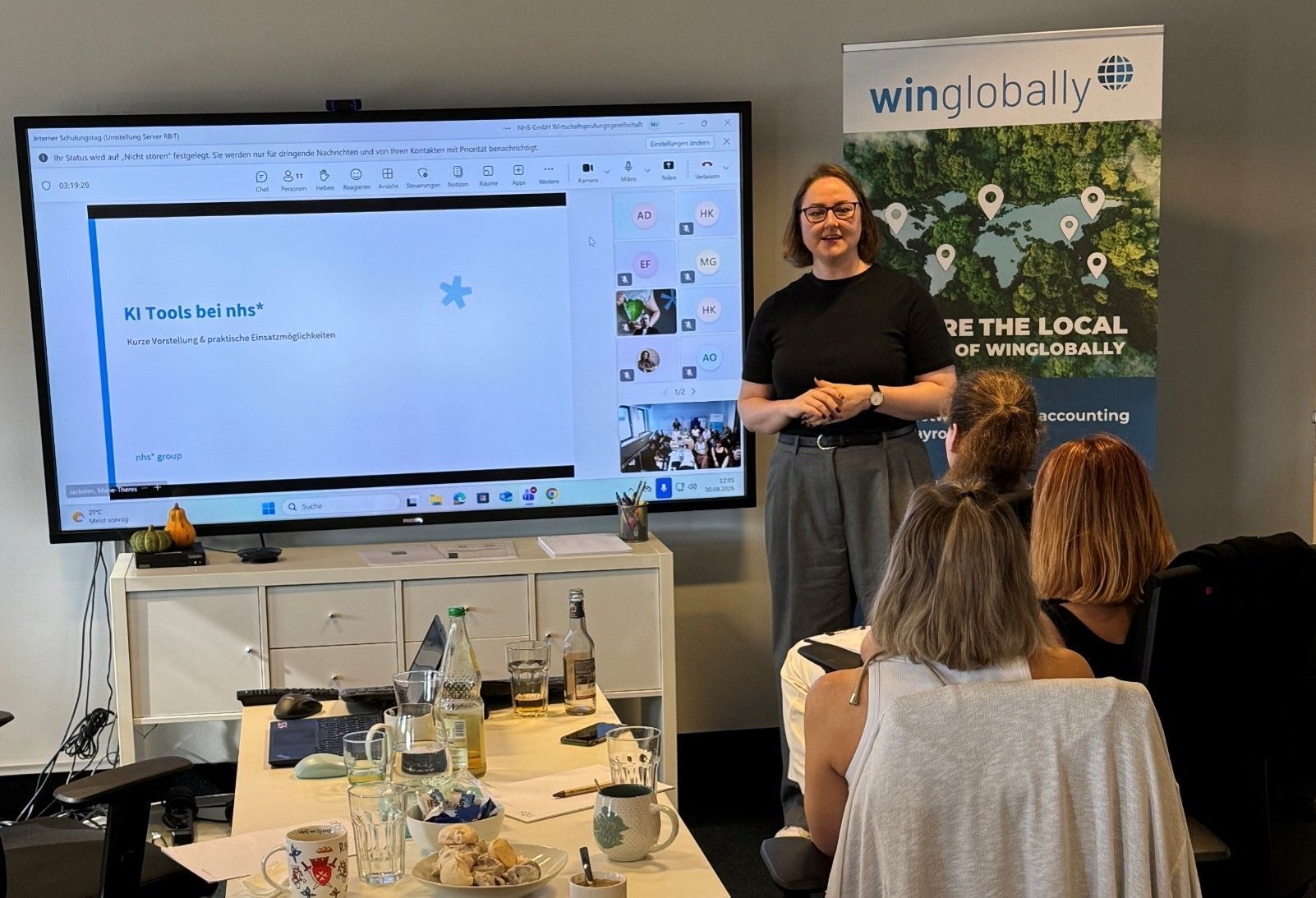
When our IT service provider informed us that, due to a server migration, we would be unable to access our work system for one day in late September, it quickly became clear: We’d put that day to other use - downtime is simply not an option for us!
So we organized an internal training day. The focus was on IT topics: from data protection and phishing to the possibilities and challenges of AI applications. A workshop on internal communication rounded out the day.
Thanks to the hybrid format of the event, colleagues who couldn’t travel to Düsseldorf that day were also able to participate. Of course, we made sure noone went home hungry. So we fed not only our minds but also our stomachs.