








News in March 2026
This March’s issues focus on employee retention through equity participation, employee vouchers and non-cash benefits, reporting gifts to the tax office, and the minimum wage and marginal earnings threshold for 2026. In the “nhs* inside” section, Managing Director and co-founder Takeshi Saikachi talks about his career, the founding of nhs*, and his early days in Germany.
nhs* spotlight
- Retaining employees through employee equity participation: Here's how it becomes tax-free
nhs* tax news
- Vouchers and non-cash benefits for employees
- Reporting gifts to the tax office
- Minimum wage and marginal earning treshold for 2026
- new act against illegal employment
- new minimum rate for business tax
nhs* inside
- Takeshi Saikachi, Managing Director and Co-Founder of nhs* in an Interview
- Do it yourself: Christmas party dinner at nhs*
- Helau und Alaf! Which costumes were in this year?
nhs* spotlight
Retaining employees through employee equity participation
Tax incentives for employee equity participation are intended to help companies attract and retain qualified employees over the long term. According to the German tax authorities and tax courts, income tax and social security contributions are only incurred at the time stock options are exercised. The date on which the options are granted or become vested, however, is irrelevant for tax purposes.
Here’s how the participation becomes tax-free:
For employee equity participation plans, an annual tax-free allowance of 2,000 euros applies under Section 3 No. 39 Sentence 1 of the German Income Tax Act (EStG).
However, this allowance can only be claimed under certain conditions. It requires that:
- the employee shareholding is a voluntary benefit provided by the employer,
- it is generally open to all employees who have been in an uninterrupted employment relationship with the employer for at least one year, and
- it constitutes a financial interest in the employer’s company granted to the employee in the form of non-cash benefits.
If it was agreed upon prior to the granting of the benefit that the equity participation would be granted in addition to salary (i.e., no salary conversion within the meaning of Section 8(4) of the Income Tax Act), the income from exercising the options is tax-exempt up to 2,000 euros per year. Furthermore, no social security contributions are due on this amount.
nhs* tax news
Vouchers and non-cash benefits for employees
Cash Payment or Benefit in Kind
Under Section 8 of the Income Tax Act (EStG), cash payments are taxable if the employee has access to the funds. These include
- earmarked cash payments,
- reimbursements of expenses,
- cash-like benefits (“cash surrogates”),
- so-called cash vouchers.
Example: If the employer reimburses a purchased voucher, this constitutes taxable cash compensation.
A voucher is only tax-exempt as a benefit in kind if, among other things, the following conditions are met:
a) Restriction to goods or services:
The voucher entitles the holder only to purchase goods or services—from the employer or from clearly defined third-party providers.
Not permitted: Vouchers that can be used exclusively to purchase other vouchers (e.g., Amazon, Zalando).
Note:
Vouchers (e.g., Rewe) that can also be redeemed for other vouchers do not automatically constitute cash wages.
b) Requirements of the ZAG:
The voucher must fall under Section 2(1)(10) of the ZAG, i.e., it must be redeemable only at a limited number of acceptance points or for a clearly defined range of products.
Not permitted: Redemption for products from third-party providers (e.g., marketplace).
The tax authorities will review:
- whether third-party vouchers are permitted
- whether cash redemption is permitted
- whether controls and documentation are in place
If documentation is missing, taxes and social security contributions will be retroactively assessed.
How to stay on the safe side:
- Obtain an income tax ruling for voucher providers
- No third-party voucher function
- Regularly review providers
- Enter into a written supplementary agreement with employees
When do gifts need to be reported to the tax office?

Although movable tangible property is tax-exempt within the family up to €12,000 – it is not exempt from reporting. This does not apply to cash, coins, precious metals, gemstones, and pearls.
According to Section 30 of the Inheritance Tax Act (ErbStG), any taxable acquisition must be reported to the tax office within 3 months. Strictly speaking, this means that even customary gifts (e.g., Christmas gifts) would have to be reported.
In practice, however, this is usually only done for larger, tax-relevant gifts.
The regulation has been in place since 1906; court rulings on customary gifts are rare. One ruling, however, deemed €20,000 at Easter no longer customary.
Important:
Larger gifts, such as a car, jewelry, or valuable coins, must also be reported.
The tax office then determines whether a tax return is required and whether gift tax is due (taking into account the tax-free allowances). With the increasing digitization of asset reporting (banks are increasingly reporting larger asset transfers systematically), the likelihood of an audit is rising.
Minimum Wage and Marginal Earnings Threshold for 2026
| Topic | Regulations effective 2026 |
|---|---|
| Minimum wage | €13.90 per hour (effective 1 January 2026) |
| Minijob threshold (monthly) | €603 |
| Midijob threshold (annual) | €7,236 (2025: €6,672) |
| Earning fluctuations | Minor monthly fluctuations above and below the threshold are possible |
| Topic | Regulations effective 2026 |
|---|---|
| Midijob (transitional category) | €603.01 – €2,000 per month |
| Insurance for Midijobs | Subject to mandatory insurance |
| Contributions for Midijobs | Employees pay reduced contributions |
| Pension insurance for Minijobs (new as of July 1, 2026) | One-time waiver of the exemption possible (previously could not be reversed) |
Act on the Modernization and Digitalization of the Fight Against Illegal Employment
The Federal Council approved the law on 19 December 2025. It includes, among other things, measures to combat illegal employment, changes to sales tax law, and the extension of retention periods.
Important tax changes:
- Input tax allocation for mixed-use properties (Section 15(4) of the Sales Tax Act): The area ratio (ratio of usable floor space) must now be applied as a priority. Another method is permissible if it yields a more precise result.
- Retention period for accounting documents:
- For banks, insurance companies, and securities firms, the period is again 10 years to better enable the prosecution of tax evasion.
New minimum rate for business tax
On 14 January 2026, the Federal Cabinet decided to raise the minimum trade tax rate from 200% to 280%. This is intended to prevent companies from relocating to certain municipalities solely for the sake of lower taxes. The law has not yet been finalized (it still needs to be approved by the Bundestag).
Other planned changes:
- Regarding real estate transfer tax, double taxation of the same transaction is to be avoided.
- The deadline for reporting such transactions is extended to one month
nhs* inside
"Time flies like an arrow"
Managing Director and founding member Takeshi Saikachi talks about his career and his early days in Germany.
Let's start at the beginning. What is your professional background?
I started my career as a marketing and sales person at a Japanese trading house in Tokyo, where I worked for ten years. The products we sold were industrial gases and chemicals. Many people don’t know that these are used in a wide variety of everyday products. For example, potato chip bags contain nitrogen to keep the chips fresh for longer.
In 2008, I took the U.S. CPA exam (Certified Public Accountant) because I wanted to start my own business. I see myself not only as an accounting professional, but primarily as a businessperson. Due to the financial crisis, there were not many job opportunities in Japan at the time, so I decided to move to India, which was an emerging market.
How did you meet Mathias and Wilhelm (the other two co-founders)?
I actually met Mathias in India. We met at a party for accounting and audit professionals. The next day, I encountered him again on a bus trip to a mosque! We were both still a bit hung over from the party, but we talked a lot. Three years later, he visited again for the professional party and offered me to work in Germany at the auditing firm he was a part of at that time.
When and why did you decide to establish nhs*?
After working with Mathias and Wilhelm for the same auditing firm for four years, I remember the evening very clearly when we decided to build our own company. It was 1 July 2015; we had dinner all together and chatted about our everyday work. Mathias, then, asked "What do you think about working for this firm?" I first gave a very diplomatic answer although I was thinking about doing something else for some time. Mathias then said that he was thinking about establishing another business. I was very happy, because running my own business was my main goal when I became a CPA. And so it all started. Jan, a good friend of Mathias and co-partner, then joined in later.

How do you feel about the upcoming ten-year anniversary?
It is really touching. I always think about the saying "time flies like an arrow."
If you think about the next ten years, they seem so far away in the future. If you think about the past ten years, that is not much time. I also remember when I first attended a ten-year anniversary party for a law firm. I thought to myself, what a fantastic success that is. And now it is already our time! It is really surprising, how fast the time has passed. I also feel a
deep appreciation for everyone who supported us.
Do you have a favourite anecdote about living in Germany?
In my first year working here in Germany, we went out to play football with some younger colleagues. It was a kind of mini football game, with fewer players and on a small pitch, similar to the basketball version of the sport. Unfortunately, I twisted my ankle. My foot was swollen and I couldn’t walk, so I decided to visit a clinic close to our workplace.
The doctor told me that it wasn’t a serious injury and that I didn’t need to worry too much. But he gave me one piece of advice: “Buy Quark!”
I went to the pharmacy and asked for Quark. They told me I should go to the nearest supermarket instead. I was very confused by the doctor’s recommendation, but when I finally found the Quark in the supermarket fridge, I decided to try it. So I dutifully ate Quark every day to help my leg heal.
Only later did I find out that I wasn’t supposed to eat it. I was supposed to put it on my ankle! That was a
very interesting cultural difference. I never would have thought of that.
Whats your favourite thing about Germany?
I really enjoy watching football here. Also German bread is fantastic, Roggenbrötchen, Mehrkornbrötchen, Kürbiskernbrötchen, Volllkornbrot, you name it.
What is your favourite travel destination?
I personally enjoy the process of travelling. So for me, it is not about the destination; the feeling of travel is more valuable to me. But no matter if the destination is in Germany or in a foreign country, if it has a stadium, it is already my favourite. I also enjoy eating local foods, using the local transportation and just seeing the behaviour of the local people living their everyday lives.
Whats your favourite sport?
I am not just a big football fan, but also a baseball fan. The Baseball World Cup is actually taking place right now. [The final was played on 17 March 2026, with Venezuela winning against the United States.]
I remember that in my first year working here in Germany, I sometimes used the baseball term “play catch” in a business context, but no one knew what I was talking about. In the United States and Japan, fathers and sons, children and neighbours often play catch. It’s a common way of spending time together and communicating in a relaxed and trusting way.
Die nhs* live

Do it yourself!
At our Christmas party, there was no sport event for once. Still, we were very active. Instead of running, jumping, or swimming, we chopped, mashed, stirred, and fried. We decided to prepare our own delicious meal together with a group cooking class. We were very proud of the finished menu. These were just our appetizers:
Bruschetta with mulled wine shallots and duck breast | Herb crêpes with salmon | Raclette potatoes | Prunes and apricots wrapped in bacon | Soup served in espresso cups | Bruschetta with cocktail shrimp | The Christmas Eve classic: potato salad with Vienna sausages.
Which costumes were in this year?
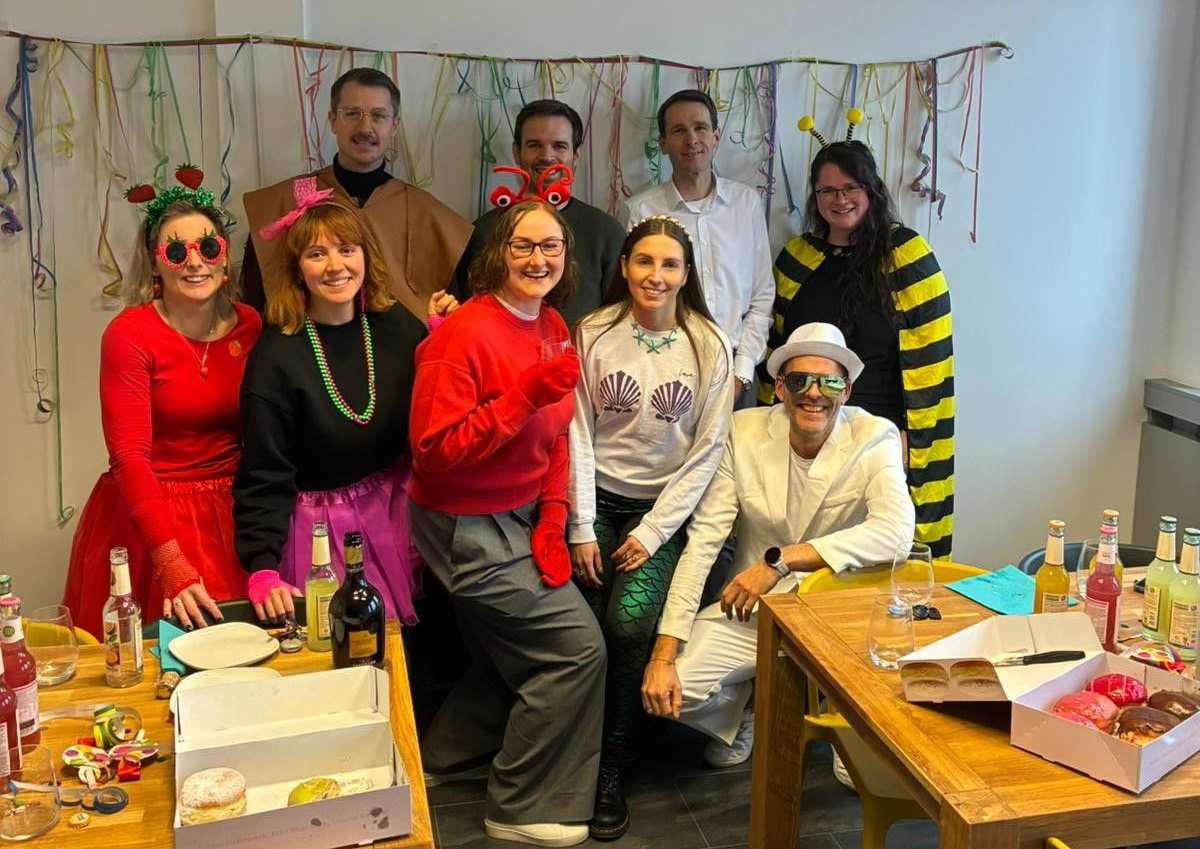
While "Rosenmontag" is a public holiday at nhs*, we had the chance to celebrate together at the office even before then. On "Altweiber", a few party-enthusiast got together and raised a toast.
As always, there were no limits to the creativity of the costumes: whether strawberry, monk, mermaid, or Jan Delay—we had it all! Three team members, who were apparently dressed as “busy auditors,” provided some extra laughs.
Even if everyday life sometimes leaves no time for dressing up, it’s still nice to forget about the daily grind for a brief moment and celebrate together with colleagues.