








News in June 2026
E-invoicing, remote work abroad, and fraud schemes related to year-end financial statements: Our June newsletter provides information on important tax changes and current risks for businesses. In the “nhs* inside” section, our colleague Anna-Katharina shares her story of growing up with nhs*.
nhs* spotlight
- E-invoices 2027: The countdown is on
nhs* tax news
- Tax Implications of Working Abroad
- The Rules for Input Tax Deductions
- The Problem of Double Taxation
- Shipping Gifts and Goods Abroad
- Be Careful with Payment Requests
nhs* inside
- Anna-Katharina, who has been with nhs* for ten years, in an interview
- nhs* turns ten
- Back to where it all began
- Every step counts
- Predict with us!
nhs* spotlight
E-invoices 2027: The countdown is on
This applies starting in 2027
XML format:
At the latest when the requirement for many companies to issue
e-invoices takes effect in 2027, the number of e-invoices received will increase significantly. In this context, the following should be noted: Previously, with a
hybrid format (e.g., ZUGFeRD)—in the event of a discrepancy between the electronic data and the readable image portion—the image portion took precedence. With the introduction of mandatory e-invoicing as of 01.01.2025, this relationship has been reversed. For hybrid e-invoices, the invoice data contained in the structured portion (e.g., XML) now takes precedence. If the structured portion of the invoice differs from the image portion, the data in the structured portion is now authoritative. The XML data set should be visualized and verified independently.
Input Tax Deduction: If a simple PDF file is sent after the transition period has expired, the invoice is not valid for value-added tax purposes. This means that if you receive only a PDF invoice from a supplier required to issue e-invoices, you will not be able to claim the input tax deduction. The same applies to the recipients of your invoices if you do not issue them properly. Consequently, in individual cases, the recipient may assert a right of retention pursuant to Section 273(1) of the German Civil Code (BGB).
Terms and Conditions and Contracts: Many existing contracts still contain provisions regarding invoicing by mail or PDF that will no longer meet the requirements of the e-invoicing mandate after the transition periods expire. Companies should therefore review their contracts and terms and conditions and, if necessary, amend them through addenda or side letters. For new contracts, e-invoicing should already be included as standard. As of the respective effective date, invoice recipients must also accept e-invoices without requiring separate consent.
| Deadline | Regulation |
|---|---|
| since 01.01.2025 | Requirement to Accept E-Invoices – All Business Owners, No Exceptions |
| until 31.12.2026: | Transitional Provision for Issuance (All Transactions); PDFs Still Permitted with Consent |
| from 01.01.2027: | Requirement to Issue E-Invoices for Companies with Prior-Year Revenue > 800,000 € (Base Year 2026) |
| until 31.12.2027 | Requirement to Accept E-Invoices – All Business Owners, No Exceptions |
| from 01.01.2028 | Transitional Provision for Issuance (All Transactions); PDFs Still Permitted with Consent |
nhs* tax news
Tax implications of working abroad
Anyone living in Germany is generally liable to pay taxes in Germany on their entire income. However, if someone works abroad for an extended period, additional tax obligations may arise.
Occasional work during a vacation usually does not pose any major problems.
In the case of longer or regular stays abroad, however, the following should be clarified in advance:
- How long one is allowed to work abroad
- In which country taxes are due
- Whether the employer is required to withhold income tax there
Conversely, employees who normally work abroad may also become subject to tax or social security contributions during longer assignments in Germany. Therefore, such assignments should be reviewed and planned well in advance.
Example: An employee of a German company moves permanently to Spain and works from there for 220 days a year. She travels to Germany for individual meetings for a total of only 20 days. Since she performs the majority of her work in Spain, her wages are generally taxable in Spain. Germany may only tax the portion of her salary attributable to the workdays spent in Germany. The employer must therefore accurately document the workdays and, if necessary, fulfill Spanish income tax obligations.

The Rules for Input Tax Deduction
The following generally applies to businesses:
- If an item is used solely for business purposes, the sales tax (input tax) paid can be reclaimed.
- If it is used solely for personal purposes, there is no input tax deduction.
If the use changes later:
- More personal use → the personal use must be taxed.
- More business use → an input tax deduction that was originally forfeited cannot be reclaimed retroactively.
If an item is used for both personal and business purposes, the business may decide for itself how to allocate it for tax purposes. Here, too, the following applies:
- More personal use → additional taxation.
- More business use → no retroactive tax refund.
A key new rule applies to organizations with a non-commercial sector, such as associations: Previously, if such an organization purchased an item, it could claim the full input tax credit, and the non-business use was later gradually “taxed.”
This is now changing fundamentally, because in this case, an input tax credit is excluded from the outset or can only be adjusted retroactively if the scope of use changes.
The problem of double taxation
In the case of an intra-community acquisition, goods are delivered from one EU member state to another. In Germany, this purchase is generally subject to tax if the buyer is a business. For certain groups (e.g., small business owners), there is a threshold of 12,500 euros per year. If this threshold is exceeded, the purchase becomes taxable for them as well.
Problem: If it is not recognized that the goods are being delivered to a business, double taxation may occur:
- once in the country of origin (foreign sales tax)
- and again in Germany
This often happens when a valid German VAT ID (DE-USt-IdNr.) is not provided.
Here’s how to do it correctly:
- Always provide your own VAT ID number when making a purchase
- Then the goods will be delivered without foreign tax (net invoice)
- The tax is paid in Germany, often with an input tax credit
Important:
- Apply for and register your VAT ID number in a timely manner
- Check invoices immediately and request corrections if necessary
- The VAT ID number must already be valid at the time of purchase
Shipping Gifts and Goods Abroad
Anyone who ships goods free of charge (e.g., as a gift or prize) to individuals in other EU countries must, as a general rule, charge German value-added tax. A tax exemption, as is the case with normal sales to other EU countries, is not possible. The reason: The recipient does not pay sales tax in the destination country, so the goods would otherwise remain untaxed.
Exceptions apply only to merchandise samples, product samples, or gifts up to 50 euros net per recipient per year. These are considered non-taxable and do not trigger value-added tax.
The regulation takes effect immediately and also applies to tax audits already in progress. The decisive factor is whether ownership of the goods is transferred to the recipient. If that is the case, it constitutes a taxable supply made free of charge. If the goods are transported to another EU country but remain the property of the company, this may instead constitute a so-called “intra-community transfer”. Under certain conditions, this is tax-exempt in Germany but must be taxed in the destination country.
Important: Gifts, samples, and goods movements should be thoroughly documented so that everything is traceable in the event of a later audit by the tax office.
Your company's financial statements: Beware of payment requests
The Federal Central Tax Office (Bundeszentralamt für Steuern) and the Federal Office of Justice (Bundesamt für Justiz) have repeatedly warned about fraudulent emails containing payment requests. These emails claim that companies have allegedly failed to publish their annual financial statements and must now transfer funds to the specified bank account. Here are the facts:
| Correct | False |
|---|---|
| There is a Federal Central Tax Office (Bundeszentralamt für Steuern) | The Bundeszentralamt für Steuern is responsible for publishing annual financial statements. |
| The Federal Office of Justice (Bundesamt für Justiz) is responsible for imposing administrative fines for failure to disclose information or for late disclosure. | Emails from the "Bundeszentralamt für Steuern” demanding payment for unpublished annual financial statements are genuine. |
| Corporations (e.g., GmbHs) and certain partnerships (e.g., GmbH & Co. KG) must publish or file their annual financial statements. | Companies are being asked to transfer money immediately in response to a surprise email in order to avoid a fine. |
| Correct | False |
|---|---|
| Violations of the disclosure requirement may result in administrative fines ranging from 2,500 to 25,000 euros. Official correspondence from the Federal Office of Justice is issued as part of a regulated procedure. | The “Bundesamt der Justiz” (incorrect official name) sends out notices of fines via suspicious emails containing unknown bank account information and attachments. |
| In case of doubt, the invoice or payment request should be reviewed with a tax advisor or accounting expert. | A sense of urgency in an email is a sign that the demand is legitimate. |
nhs* inside
Ten years at nhs*
Team Assistant Anna-Katharina Lansmich talks about how she grew up with nhs*.
How did you start at nhs*?
It’s a long story. My mother has been working at nhs* since it was founded, and she realized very early on that nhs* could use some extra help. At the time, I was 14 years old and started out as a student assistant, working two hours a week. I had a fun job interview: I had to sort professional literature. Wilhelm (a partner at nhs*) explained my tasks to me, and then I had to get right to work.
So my duties as a part-time assistant included sorting professional literature, but also scanning receipts, creating folders, and other small organizational tasks. Back then, we weren’t as digital as we are today. Once I was done with school and just had to study for my Abitur, I increased my hours at the office to part-time. Then I completed various internships in other fields, including a six-week full-time internship at nhs*, where I mainly gained a deeper insight into financial accounting. Eventually, I worked here part-time for a year before starting my training as a veterinary technician. But even during my training, I continued to work at nhs*, this time on a two-hour basis. Since finishing my training, I’ve been working part-time at nhs* again and handling a wide variety of internal tasks.
Why did you decide to go back to working at nhs* two days a week?
I love my job as a veterinary technician, but I really enjoy having variety in my life, and the two jobs are simply complete opposites. Plus, I have a lot of fun working here, and nhs* is just a part of my life. The flexibility of an office job is, of course, a big advantage, whereas as a veterinary technician, you’re tied to opening hours.
How would you describe the nhs* team?
Very warm and welcoming. We’re a team of equals where you can openly discuss mistakes or suggestions. You also don’t have to be afraid of making mistakes, because
to make mistakes is human, and we work together to figure out how to fix them. You’re never really alone, and you can always count on the others.

What’s your favorite story or anecdote from your ten years at nhs?
My favorite story is probably a misunderstanding between my mom and Takeshi (a partner at nhs*). We’d received a fake invoice, and Takeshi placed the invoice on my mom’s desk with a handwritten note that read “f r a u d u l e n t.” My mom then asked, “Wer ist Frau Dulent?” ("Who is Ms Dulent?") We even immortalized “Frau Dulent” as our team name at our first Christmas party.
What’s one thing you can’t do without in your daily work routine?
Something in my ears. I always need constant background noise to concentrate, and I’m pretty much always listening to music or audiobooks that I’ve heard a thousand times already.
How does your work at nhs* help you in your work at the veterinary practice, and vice versa?
At the practice, it’s helped that I’ve been working since I was 14. Because of that, I was used to understanding
work instructions as such and was able to take them on much more quickly. I think that’s much harder if you’re coming straight out of school and haven’t worked before.
In addition, insider knowledge from tax consulting has been helpful to me. Of course, I’m not a tax advisor, but through my day-to-day work at the office, I already knew about some very practical things that I could use as food for thought in my practice. For example, in our practice, we used a highlighter to mark the numbers on an EC receipt for the cash count. But I knew from scanning receipts at the nhs*: That’s thermal paper—the numbers won’t be legible in two weeks. So the solution: just draw a line with the highlighter underneath the numbers. Conversely, working at the practice helped me truly appreciate the peace and flexibility of the office.
What’s your favorite vacation destination from your travels so far? And where would you absolutely love to go someday?
My most unforgettable trip so far was to Namibia. I was there as a volunteer at a wildlife park, taking care of the animals. It’s definitely an experience you’ll never forget—standing face-to-face with a lion while holding a
piece of meat in your hand. In the future, I’d love to see whales in the wild. Orcas have fascinated me ever since I was little. I’ve heard that Norway is a great place to go whale-watching and that you can even swim or snorkel with orcas there.
nhs* live
nhs* turns ten
We’ve been around for ten years already! Of course, that called for a proper celebration. Our two-day program kicked off in Düsseldorf at the cokon event venue with a very insightful workshop day where the team could decide on the topics to be discussed. Together, we tackled important topics related to our day-to-day work. We skipped a lengthy look back at the past years, because our motto for this anniversary was:
Look ahead! All team members were open to change and ready to work together to make it happen. On Saturday, we successfully wrapped up our workshop in Essen at Lake Baldeney before the athletic part of the program began. When do you ever get the chance to practice archery together? Afterward, with the summery temperatures, a dip in the lake was, of course, a must.


Back to where it all began
As the German member of the international network winglobally, we travel twice a year to attend our network meetings. The most recent meeting took place in Paris, the city where the network was founded ten years ago. Accordingly, our host, ORCOM, organized a particularly festive event. In addition to current active members, former members and long-time colleagues were also invited. After the meeting in Paris La Défense and presentations on cybersecurity, we headed to a dinner cruise on the Seine for the anniversary celebration. Paris showed itself at its best, and on that balmy summer evening, we sailed past some of the city’s most iconic landmarks—from the Eiffel Tower, under the Pont Neuf, and past Notre-Dame. The meeting demonstrated once again how important personal contact is in international collaboration and how fortunate we are to belong to a network with such strong, shared principles.
Every step counts
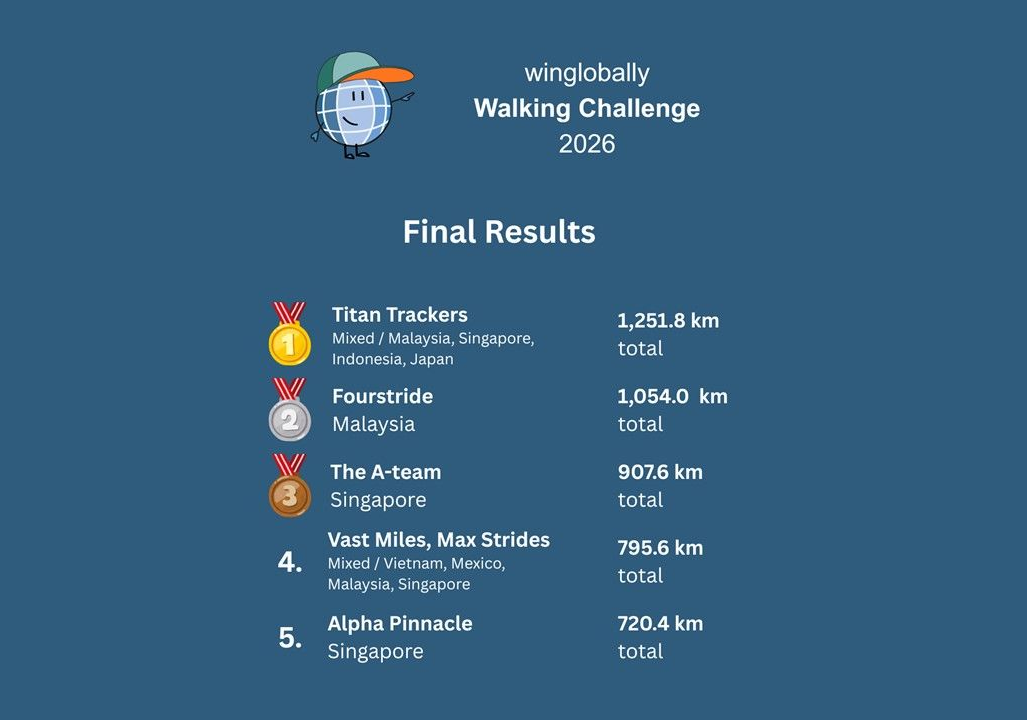
We celebrated the first implementation of the winglobally Walking Challenge this year. For 16 days we counted kilometers in teams of four. The tempo was irrelevant - everybody was able to join. With 40 different teams from ten different countries, the network welcomed the Walking Challenge with enthusiasm.
In this iteration we counted kilometers traveled on foot and by bike. Some participants took lenghtly hikes, others rode their bike to the office everyday. In total, we achieved over 1,200 km by bike and almost 20,000 km on foot. Besides crowning the best three teams with the most kilometers, we also integrated a team photo challenge and a jury picked the best picture out of 25 submissions.
Predict with us!
Have you heard about our Kicktipp game yet? In the NHS Superleague, our team places bets alongside all our soccer-loving friends and clients. The first-place winner always gets a custom jersey of their choice, and in the Bundesliga Kicktipp games, second- and third-place winners can also look forward to a little surprise. At the end of the 2025/26 Bundesliga season, we congratulated the Kicktipp game user “Maskottchen” on taking first place and gifted them with a DFB jersey, which was perfect to set the mood for the World Cup. But of course, the most important thing is having fun! Our FIFA World Cup Kicktipp game is currently underway, and it’s really exciting. Together, we’ve already witnessed the rapid rise and fall of some participants. Of course, we will also making predictions for the 2027/28 Bundesliga season and look forward to welcoming all new participants. You can join now already, so you don't miss the start next year: